Rail freight works where sea is too slow and air is not justified by cost
Market data update: October 2026
- Type
- Rail freight
- Route
- Europe - Asia (New Silk Road) · China, Central Asia
- Cargo
- Standard containers (FCL/LCL) · out-of-gauge cargo (special wagons)
- Status
- A compromise between sea transit time and air freight cost
- How long does rail freight from China to Poland take?
- When does rail beat sea freight?
- What cargo can travel by rail?
- Is the rail route stable?
- Is rail-sea intermodal transport possible?
Rail freight from Asia to Europe sits between sea and air - faster than sea, significantly cheaper than air. It works for cargo for which sea transit time is too long, but whose value or nature does not justify air freight cost.
Its main limitation is not price or volume, but dependence on border routes - which is why the corridor is agreed at the start of the conversation, not at the end.
The value of goods carried by rail from China to Europe grew sevenfold in under a decade
According to a report by the Belt and Road Initiative Promotion Office and China State Railway Group, the annual value of cargo carried by rail on the China-Europe route grew from USD 8 billion in 2016 to USD 56.7 billion in 2023. The same report estimates rail freight cost at roughly one fifth of air freight cost.
In 2024, trains on the China-Europe route made about 19,000 journeys carrying more than 2 million TEU - a growth of about 10% versus 2023, and the pace in 2026 is even higher.
Rail transit time from China to Poland is usually about 20 days - and it is always an indicative term
Standard rail transit time from China to Poland falls within a limit of up to 20 days - 12 days is not a realistic figure. Cartrag never guarantees a transit deadline - all quoted times are indicative and can change at any point due to political risk, maintenance works on the route or congestion at border crossings.
Transport runs exclusively on the northern route - Kazakhstan, Russia and Belarus, with the border crossing at Małaszewicze. This route is prone to temporary border closures - in September 2025 Poland completely suspended rail and road traffic with Belarus for about two weeks during the Zapad-2025 military exercises.
Additionally, some commodity groups cannot travel by rail on this route due to restrictions imposed on the Russian side - the scope of those restrictions depends on the cargo category and needs checking for each specific order.
Rail freight cost depends on the container, the season and space availability on the route
The price is influenced by the type of container or wagon, distance and seasonality - congestion at the Małaszewicze border crossing usually intensifies between September and November, which translates into both price and availability of slots.
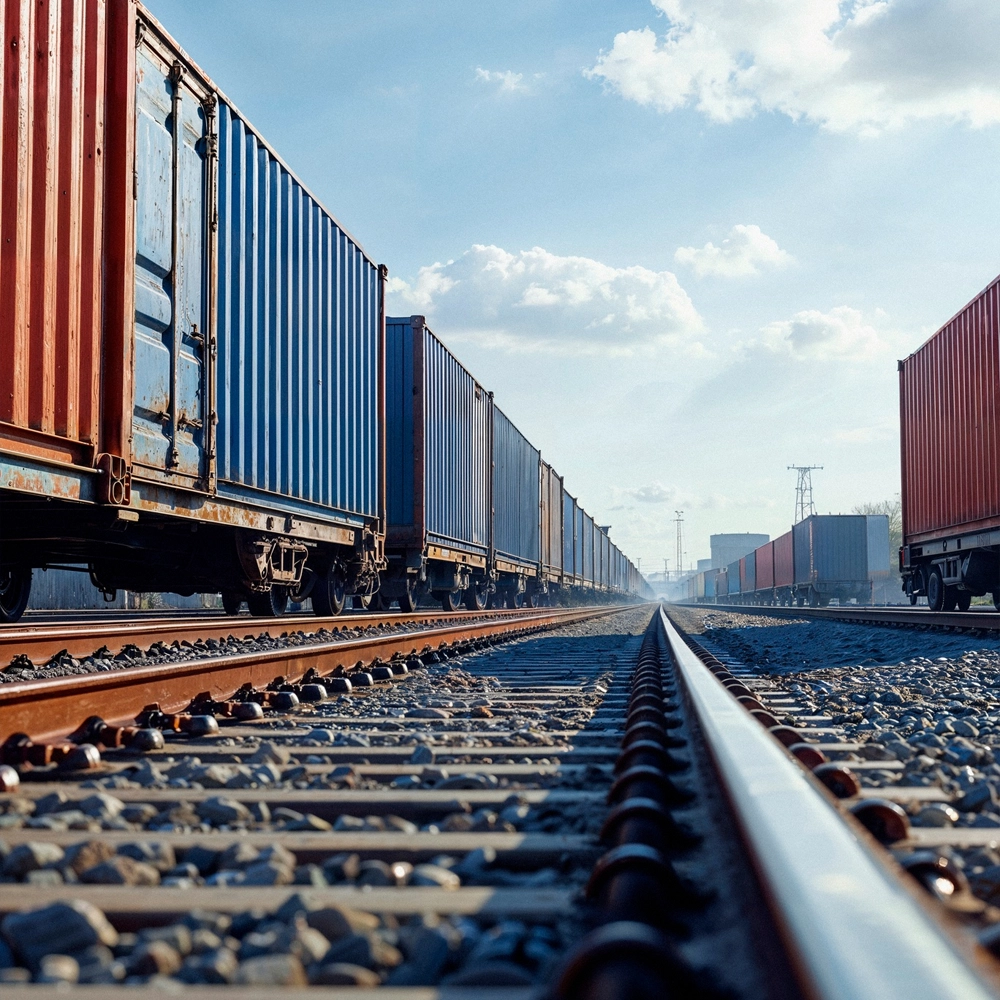
Rail transport handles standard containers (FCL, LCL) under international consignment documentation
A rail order can cover a full container (FCL) or consolidation of smaller lots (LCL), based on standard international consignment notes - CIM (Europe) and SMGS (Asia, Russia, CIS countries), which in rail transport bridge a route crossing both legal systems.
"Rail is rarely the client's first choice - it usually ends up with someone for whom the ship is too slow and the plane too expensive. Our job is to show it is not a compromise in the bad sense."
Oversized cargo requires special wagons, not standard containers
Goods exceeding standard container dimensions - machinery, structural elements, industrial components - travel on special wagons (OOG), analogous to flat rack or open top solutions in sea transport.
Rail-sea and rail-road intermodal lets you combine the strengths of both modes
The rail-road combination works on the same principle as in air transport - the rail leg handles the main route, while road haulage covers collection from the shipper and delivery to the final consignee. A rail-sea combination makes sense for cargo for which part of the route (e.g. from an Asian port to a rail hub) is faster or cheaper by sea.
When comparing rail, sea, air and road transport, start with cargo parameters
| Transport | Key advantage | Typical use |
|---|---|---|
| Rail | A compromise between time and cost | Selected Europe-Asia connections |
| Sea | Cost at large volumes | Long-haul routes, containers, larger lots |
| Air | Speed | Urgent and high-value shipments |
| Road | Flexibility | Regional transport and door-to-door deliveries |
Rail freight works especially well in industries with predictable delivery cycles
Rail transport is most often chosen by industries where deliveries can be planned several weeks ahead while sea transport is too slow. These include electronics and industrial components, automotive - especially parts and subassemblies produced against a specific assembly schedule, machinery and industrial equipment, clothing and fashion goods with a seasonal delivery window, and e-commerce goods bound for European distribution centres. To a lesser extent, rail also carries medical devices and pharmaceuticals requiring controlled temperature.
Summary - rail wins where sea is too slow and air is not cost-effective
FAQ - rail freight
Usually up to about 20 days. This is always an indicative term - Cartrag does not guarantee transit time, because it depends on political risk, maintenance works on the route and congestion at border crossings.
Usually when a 45-60 day sea delivery time is too long and air freight cost is unjustified - at typical values, rail transport shortens delivery time by more than a dozen days compared with sea.
Standard containers (FCL and LCL) and out-of-gauge cargo on special wagons - especially goods with a higher unit value, such as electronics or industrial components. Some commodity groups cannot travel this route due to restrictions on the Russian side - the scope depends on the cargo category.
The route via Kazakhstan, Russia and Belarus (the Małaszewicze crossing) is sometimes temporarily closed for political reasons, as in September 2025 during the Zapad military exercises. This is a risk to factor into deadline planning, not an exception to the rule.
Yes, Cartrag organises import and export documentation and transit procedures for rail shipments.
Yes - rail-sea and rail-road combinations make sense when individual route legs are faster or cheaper by another mode of transport.
Request a rail freight quote
Send us the cargo parameters and the route. We will come back with a quote.
54°32′N 18°33′E / CARTRAG / RAIL FREIGHT